Common Challenges in Finding manufacturers in China for wholesale orders
Wholesale manufacturer discovery works best when buyers start with a comparable product brief and then verify the identity, capability, evidence, and commercial assumptions behind each offer. A directory entry or low quote is only a lead for further review.
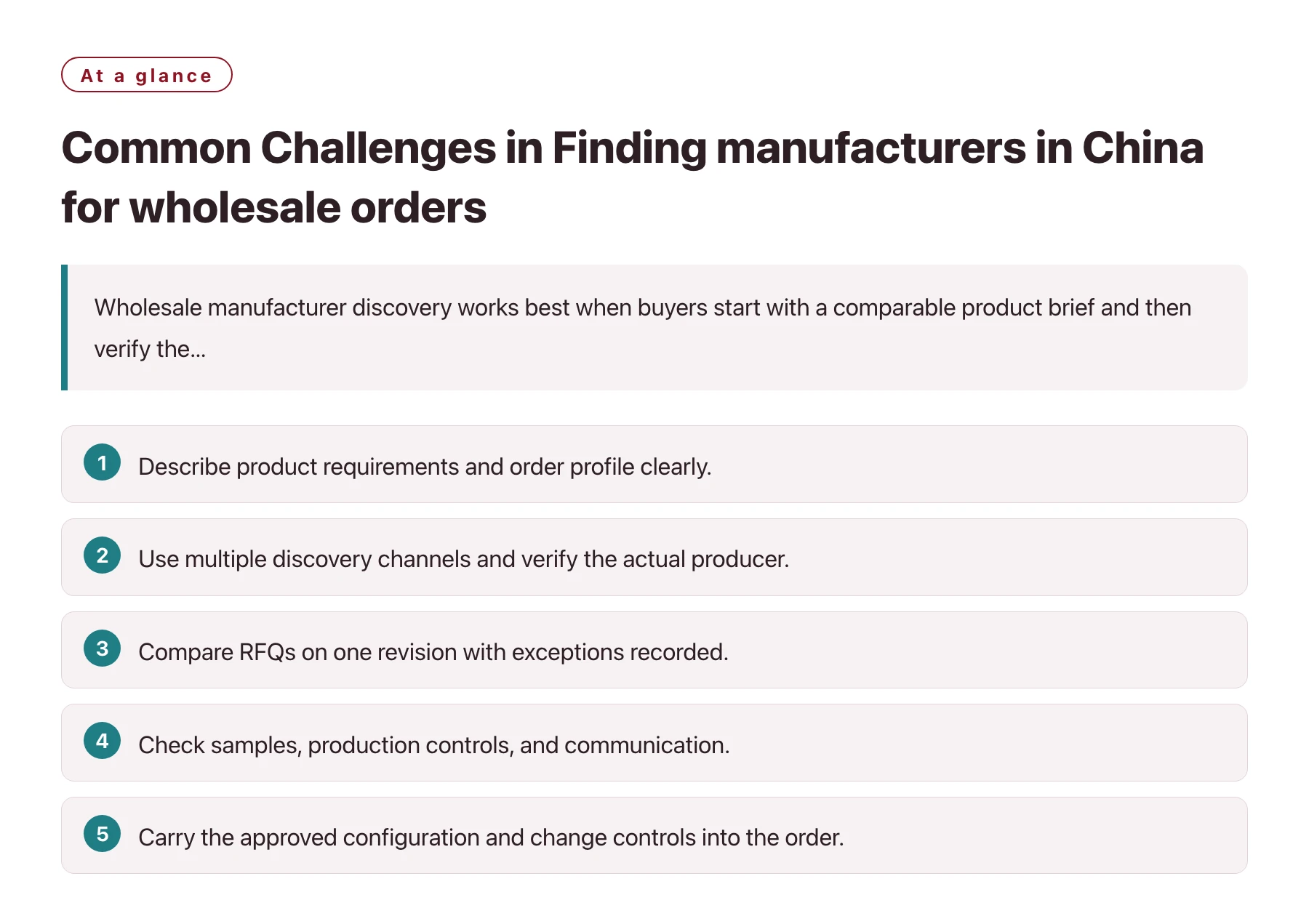
Key takeawaysDescribe product requirements and order profile clearly. · Use multiple discovery channels and verify the actual producer. · Compare RFQs on one revision with exceptions recorded. · Check samples, production controls, and communication. · Carry the approved configuration and change controls into the order.
A disciplined discovery process turns a longlist into an evidence-based shortlist. It also makes unresolved risks visible before an order depends on them.
1. Define the product and order profile
A wholesale sourcing search starts with more than a product name and target price. Prepare a description of intended use, key specifications, variants, packaging, destination market, first order quantity, repeat potential, and launch date. Mark mandatory requirements and negotiable preferences separately. This gives every candidate the same basis for responding and helps screen out suppliers that only match a broad keyword.
State the expected commercial model: one purchase, recurring replenishment, seasonal demand, or a forecast with uncertain volumes. Clarify whether you need a factory, a trading company, or a distributor and why. If several product categories are involved, decide whether one capable supplier or a coordinated group is more appropriate.
2. Build a longlist from more than one route
Combine referrals, trade directories, industry exhibitions, professional networks, and direct research. Use each channel to discover candidates, not as proof of suitability. Record the source, date, product claims, company name, location, and initial contact for every lead. Avoid relying on copied listings that repeat the same unverified factory profile.
Search using product function, material, process, component, and local industry terms as well as the English product name. A specialized manufacturer may describe its work differently from an overseas buyer. Keep separate entries for a factory and its export-facing trading entity until the relationship is verified.
3. Screen business identity and facility claims
The U.S. Department of Commerce recommends due diligence when assessing foreign business partners. Confirm the contracting entity, registered address, authorized contacts, payment beneficiary, and the facility that will actually make the goods. Ask for a plain explanation where the seller, brand, exporter, and manufacturer are different parties. [1]
Compare registration or business documents with the entity on the quotation and invoice. Independently confirm changed bank details using a previously verified contact. Record the date and method for each check. These steps help reduce identity ambiguity but do not guarantee future performance or replace legal review where needed.
4. Check capability against the specification
Ask the candidate to map each important requirement to its process, equipment, quality control, and evidence. Request the proposed production location, relevant product examples, available capacity, typical lead time, and constraints. Where a requirement is outside normal capability, ask what would be subcontracted and who controls that step.
Do not treat a factory tour or polished catalogue as a capability audit. Ask for dated evidence tied to comparable items, such as production flow, equipment list, in-process checks, measurement records, or sample history. Distinguish what was observed from what was asserted and note evidence gaps for later verification.
5. Issue a comparable wholesale RFQ
Send the same specification revision, annual or order quantity assumptions, packaging instructions, delivery location, and response deadline to each shortlisted supplier. Ask for unit price breaks, tooling or setup charges, minimum order quantity, production lead time, payment terms, quote validity, sample cost, and delivery basis. Request explicit exceptions instead of a generic confirmation.
Use a response table with one row per requirement and columns for offered value, evidence, deviation, price effect, and supplier question. This makes incomplete replies visible and speeds follow-up. If suppliers propose alternatives, keep them separate from the compliant offer so the buyer can compare the tradeoff deliberately.
6. Evaluate sample and production readiness
Agree what the sample will prove: dimensions, finish, function, fit, packaging, or assembly. Mark sample identity, version, and date. Keep an approval record and return comments against the requirement rather than relying on “looks good.” A pre-production sample is not evidence that a full wholesale batch will match without ongoing controls.
Before placing a large order, define production checkpoints, inspection method, defect handling, change approval, and lot traceability. For a first order, consider a bounded pilot when it meaningfully tests the process and does not create disproportionate shipping or compliance risk. Agree what must be true before scale-up.
7. Compare total cost and operating risk
Normalize price for currency, quantity breaks, packaging, labeling, tooling, samples, inland movement, freight assumptions, and expected inspection or laboratory costs. Clarify which items are estimated and which are firm. A low unit price may depend on a higher minimum order or reduced packaging that changes landed cost.
Compare responsiveness, evidence quality, schedule reliability, capacity flexibility, defect response, and financial exposure alongside price. Set pass/fail gates for mandatory requirements, then score preferences with weights agreed in advance. Run a sensitivity check for exchange rates, volume, freight, and schedule changes if they could alter the supplier ranking.
8. Validate references and communication
Ask for relevant trade references with permission and focus the questions on product category, order pattern, communication, handling of defects, and what the supplier did when an issue arose. Treat a reference as one input. Review redacted inspection or corrective-action examples to see whether the supplier documents findings and closes them.
Identify the operational contact who will handle samples, production, quality issues, and shipment documents. Test how clearly the team responds to a realistic clarification. Agree language, time zone, update cadence, escalation route, and how verbal decisions are confirmed in writing.
9. Protect the decision process
Disclose any buyer-side or intermediary relationships that may affect recommendations. Keep supplier selection, final specification approval, price authorization, sample acceptance, and production release with named buyer decision makers unless authority is explicitly delegated. Preserve the comparison, evidence, exceptions, and reasons for selection.
A broad assurance such as “export experience” is not a substitute for checking the exact product and order. Maintain an open-questions list with an owner and deadline. If a key fact cannot be verified before award, decide whether to obtain independent evidence, use a pilot, or accept the risk with written approval.
10. Convert discovery into a controlled order
Before award, reconcile the selected quote with the approved specification, sample, packaging, delivery assumptions, inspection plan, and commercial terms. Attach the final revision to the purchase order and define how conflicts between documents will be resolved. Require written approval for subsequent changes to material, site, process, or subcontracting.
Buyers seeking JS Sourcing can use this sequence to organize manufacturer discovery, compare wholesale offers, and track unresolved evidence. Confirm current service terms directly and retain the buyer’s authority over product, commercial, and compliance decisions.
Sources
Frequently asked questions
How do I find manufacturers for wholesale orders in China?
Use several discovery channels, then verify the actual production entity, product fit, evidence, quotation assumptions, and communication process.
Is a supplier directory enough to approve a factory?
No. A directory can help identify leads, but identity, capability, product evidence, and commercial terms need proportionate verification.
What should I include in a wholesale RFQ?
Include specification revision, variants, quantity assumptions, packaging, destination, delivery timing, and a response table for prices and exceptions.
Should I begin with a large order?
A bounded pilot may test process fit when useful, but set measurable criteria and account for product risk, shipping cost, and compliance needs.