Reuse Cycles in Formwork Panels: What Actually Drives Them
Reuse counts decide the true cost of a formwork panel, and the published spread is wide: high-grade sheets are quoted at 10–20 pours, an economical black panel at roughly 3–5. Core density, glue class, film weight and edge handling account for most of that gap, and only the first three arrive from the factory.

Key takeaways
- Published reuse runs to 10–20 pours for high-grade formwork plywood and roughly 3–5 pours for an ordinary black film panel.
- Film weight is published at 165 g/㎡ for a smooth surface and 130 g/㎡ where handling weight matters more than surface life.
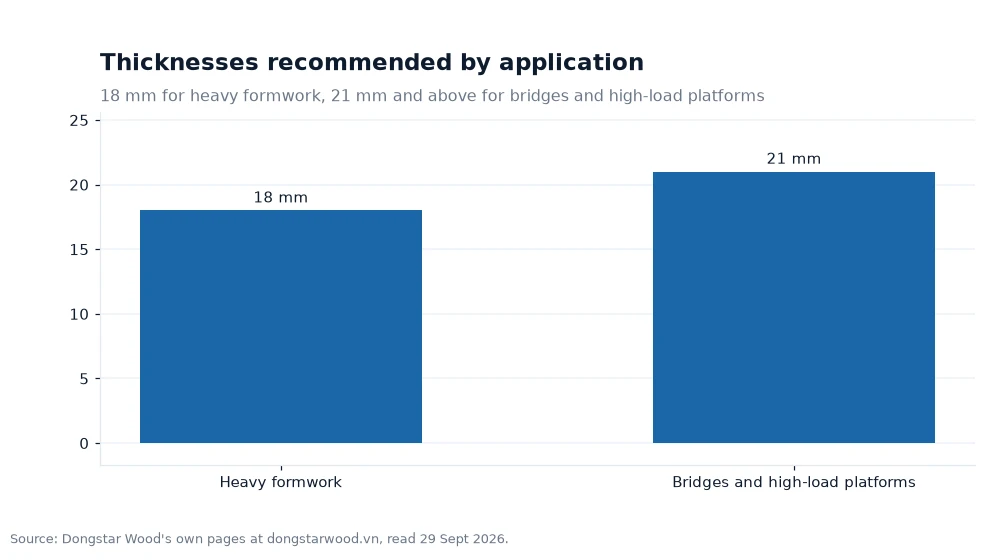
- Thickness guidance puts 18 mm on general heavy formwork, with 21 mm and above for bridges and high-load platforms.
- Edge sealing between pours is a site habit rather than a factory property, and it moves the last few cycles of any panel.
What the published reuse range covers
The published statement is specific: high-grade formwork plywood can be reused up to 10–20 times in concrete pouring. Read that as a band rather than a promise, because it comes from laboratory behaviour under controlled stripping, not from a panel that has spent a winter on an open deck between pours.
The band still tells a buyer something useful. A panel quoted at the top of the range carries a denser core, a heavier phenolic film and a better-sealed edge than one at the bottom, and the price difference between them is usually smaller than the difference in the number of pours each one survives. Anyone comparing offers can start from the published Film Faced Plywood description, where core, glue class and film weight appear beside the reuse figure instead of apart from it.
Film weight sets the surface, the core carries the load
Two film weights appear on the published pages: a smooth-surface option at 165 g/㎡ and a lighter build at 130 g/㎡. A heavier film protects the surface texture for longer and holds a flat face against repeated cleaning, while the lighter film keeps the panel easier to lift and handle on site.
| Item | Published figure | What it changes |
|---|---|---|
| Smooth-surface film | 165 g/㎡ | How long the face survives cleaning between pours |
| Second film option | 130 g/㎡ | Panel weight and handling effort on site |
| High-grade reuse | 10–20 pours | Contact area delivered by one sheet |
| Ordinary black panel reuse | Roughly 3–5 pours | Short-cycle work where the schedule leads |
| Thickness for bridges and high-load platforms | 21 mm and above | Load carried per pour |
Cores and glue: where the extra cycles come from
The published core list includes Birch, Eucalyptus, Acacia, White Hardwood, Rubber and Combi, and each one trades density against handling weight. Eucalyptus is named for compression resistance and bending performance, acacia for load bearing, and a combi core mixes species to keep the panel manageable on a scaffold.
Glue is the other half of the equation. The published classes are E0, E1, E2, MR, WBP and Phenolic Dynea, and repeated wet-dry cycling is where the choice shows up. A buyer who specifies the glue class on the drawing gives the mill a checkable line instead of a general instruction to make a durable panel.
Thickness guidance: 18 mm in general, 21 mm under load
Published recommendations put 18 mm on heavy formwork as the general answer, and 21 mm or more on bridges and high-load platforms. The reason is deflection: a thicker panel holds a flatter soffit between props, which reduces patching and cutting back after the formwork comes away.
Sizes move with the thickness. Published formats run from the 1220 × 2440 mm sheet up to custom panels, with 1250 × 2500 mm and 1500 × 3000 mm in between and a ceiling of 1830 × 3830 mm, so a pouring sequence can be planned around a format rather than around a cut list.
Worked example: contact area from one panel over its life
Take the 1250 × 2500 mm format: 1.25 m × 2.5 m works out at 3.125 m² of panel a sheet. At ten pours that delivers 10 × 3.125 = 31.25 m² of concrete contact (example); at twenty pours the same sheet delivers 20 × 3.125 = 62.5 m² (example), twice the coverage from an identical footprint.
Put that against a slab package of 12,500 m² of contact area. At the top of the range that work needs 12,500 ÷ 62.5 = 200 panels (example); at the bottom it needs 12,500 ÷ 31.25 = 400 panels (example). Doubling the reuse band halves the panel count, which is the whole commercial argument for specifying at the top of it.
Edges, stripping and storage decide the last few pours
The film protects the face; the edge is where water gets in. Sealed edges, a release agent applied consistently and panels stacked flat on battens between pours all preserve the layers that hold the panel together, and a chipped corner is the point where delamination usually starts.
Stripping matters as much as pouring. Panels levered off the concrete rather than lifted away take damage on the face and the edge at the same time, and once a face is scored the surface finish it leaves behind changes for every pour that follows.
How to read a reuse figure inside a quotation
Treat a reuse number as a specification item to be questioned rather than a headline. Ask which core, which glue class and which film weight sit behind it, then compare that combination with the number of pours your own programme actually needs before the panel reaches retirement.
The comparison only works when the figures sit on the same basis. A supplier quoting a range without naming the film weight or the adhesive leaves the buyer unable to check whether the panel in the offer is the panel used in the trial.
Evidence matters more than description at this point. Ask which panel the published band was measured on, then match its core, film weight and adhesive class against the panel in the offer; where the two differ, the cycle count in the offer is an assumption rather than a figure.
Sort the decision by programme length as well. A bridge deck or a high-rise core that pours for months justifies a denser core and the heavier film, while a short retaining wall or a foundation run is better served by the economical panel and the money it leaves in the budget.
Whichever way the choice goes, log what the panels actually do on site. Noting the pour at which each sheet was retired gives a contractor its own reuse data, which is a stronger input for the next order than any published range.
Storage finishes the picture. Panels stacked flat on battens, clear of standing water and never left overhanging a slab edge come back to the next pour with their faces and edges intact.
Frequently asked questions
Does a heavier film always mean more pours?
It helps, but it is not the only input. Film weight at 165 g/㎡ protects a smooth surface for longer than the 130 g/㎡ option, while core density and glue class carry the structural part of the cycle count. Edge damage on site can retire a panel long before the face wears out.
Which adhesive class should I specify for repeated use?
The published classes are E0, E1, E2, MR, WBP and Phenolic Dynea, and repeated wet and dry cycling is what separates them in service. Name the class on the order rather than describing durability in words, so the delivered batch can be checked against the specification.
What should be inspected before a container of formwork panels ships?
The export workflow names two checks a buyer can ask to see: how even the panel thickness runs across the batch, and whether the core build holds together. A mill that tests on its own bench can record both per shipment, which is faster than discovering either one after the panels arrive on site.
Where the specification goes next
Two variants of the same product are worth a look before a formwork package is priced. Buyers working at height should read the anti-slip surface option for walkboards and access platforms, and anyone balancing a cycle count against a budget can compare it with the economical black film panel built for shorter service.
Reuse bands, film weights and thickness guidance were copied from that the factory's own website, checked on 29 Sept 2026 as the basis for this article as the basis for this article as referenced in this comparison[1].